Signed in as:
filler@godaddy.com
Signed in as:
filler@godaddy.com
Gabriela McAllister’s work focuses on restoring stability at the level where clarity, judgment, health, and effective action naturally reorganize.
Over time, she observed that lasting change does not come from effort, insight, or willpower alone — but from addressing the underlying conditions that govern how a system responds under pressure. When those conditions stabilize, movement becomes efficient, decisions become cleaner, and performance becomes sustainable without force.
Her approach is integrative by necessity. Human physiology, nervous system regulation, relational dynamics, environment, and responsibility cannot be separated in practice — particularly for individuals operating in complex or high-stakes contexts. Rather than treating symptoms in isolation, her work attends to the coherence of the whole system.
Clients often come to Gabriela seeking support with health, stress, or life transitions. What they discover is a form of guidance that extends naturally into leadership, decision-making, and long-term stability — without being framed as coaching, therapy, or optimization.
Her work is applied privately and selectively, allowing for depth, precision, and continuity. It is not performance-based, motivational, or prescriptive. Change is measured not by intensity, but by durability.
Gabriela’s role is not to direct outcomes, but to hold the conditions in which clarity can emerge and action can proceed with far less effort than before.
Gabriela also serves in executive leadership roles supporting high impact animal welfare initiatives.
Over years of observing these patterns across very different circumstances, Gabriela identified recurring structural principles beneath seemingly unrelated problems.
Connected Energy® Method™ developed from that work: a way of identifying and addressing the conditions producing an outcome rather than working only where the problem becomes visible.
Connected Energy® Method™ examines the connection between health, behavior, performance, and the structure in which a person or animal is living and functioning—particularly when significant health problems, persistent dysfunction, behavioral changes, or recurring patterns remain despite considerable care, expertise, or effort.
What structure is producing or sustaining what we are seeing?
The presenting problem matters. But the presenting problem and the conditions producing it are not necessarily the same thing.
A person may be facing a serious health condition, chronic physical difficulty, behavioral or emotional changes, problems with performance, or a life that is outwardly successful but increasingly difficult to sustain.
An animal may present with physical symptoms, changes in behavior or performance, difficulty recovering, unexplained reactions, or patterns that persist despite appropriate veterinary care, training, management, and attention.
In either case, CEM looks beyond the isolated outcome and examines the larger system in which it is occurring—including physical health and function, not simply behavior, performance, or circumstances.
That can include physical health and function, accumulated load, patterns of compensation, environment, relationships, behavior, decision-making, identity, rhythm, recovery, demands placed upon the system, and whether the existing structure supports the health, stability, and functioning of that particular person or animal.
A person can be extraordinarily capable of succeeding within a particular life, profession, relationship, or role without that structure actually being right or sustainable for them.
An animal can continue performing, complying, compensating, or carrying a physical or environmental demand long after the underlying system has begun struggling with it.
Being able to carry something is not evidence that the system should be carrying it.
CEM therefore pays particular attention to compensation. A system can compensate remarkably well—sometimes for a very long time. The eventual symptom, diagnosis, behavioral change, or performance problem may be the point at which the difficulty becomes visible, but it does not necessarily tell us everything about the conditions surrounding it.
This is why CEM works from several foundational principles:
Stability Precedes Expansion.
Cause Over Effect.
Structure Determines Outcome.
Remove Force, Establish Rhythm.
In health-related work, CEM does not replace appropriate medical or veterinary diagnosis and treatment, nor does it assume that a particular life circumstance or structural problem caused a specific disease. CEM examines a different layer: the larger system in which that disease, dysfunction, or change is occurring.
What has the system been compensating for?
Where is stability being lost?
What conditions are reinforcing the existing outcome?
What can actually be changed?
And what structure would better support health, stability, function, and performance going forward?
Because whether the presenting issue involves health, behavior, performance, relationships, decision-making, or a major transition, the fundamental question remains the same:
Are we trying only to manage the outcome—or are we willing to examine the structure that keeps producing it?
Recognizing a pattern can happen quickly. Changing the structure that has been producing or sustaining it is a different process.
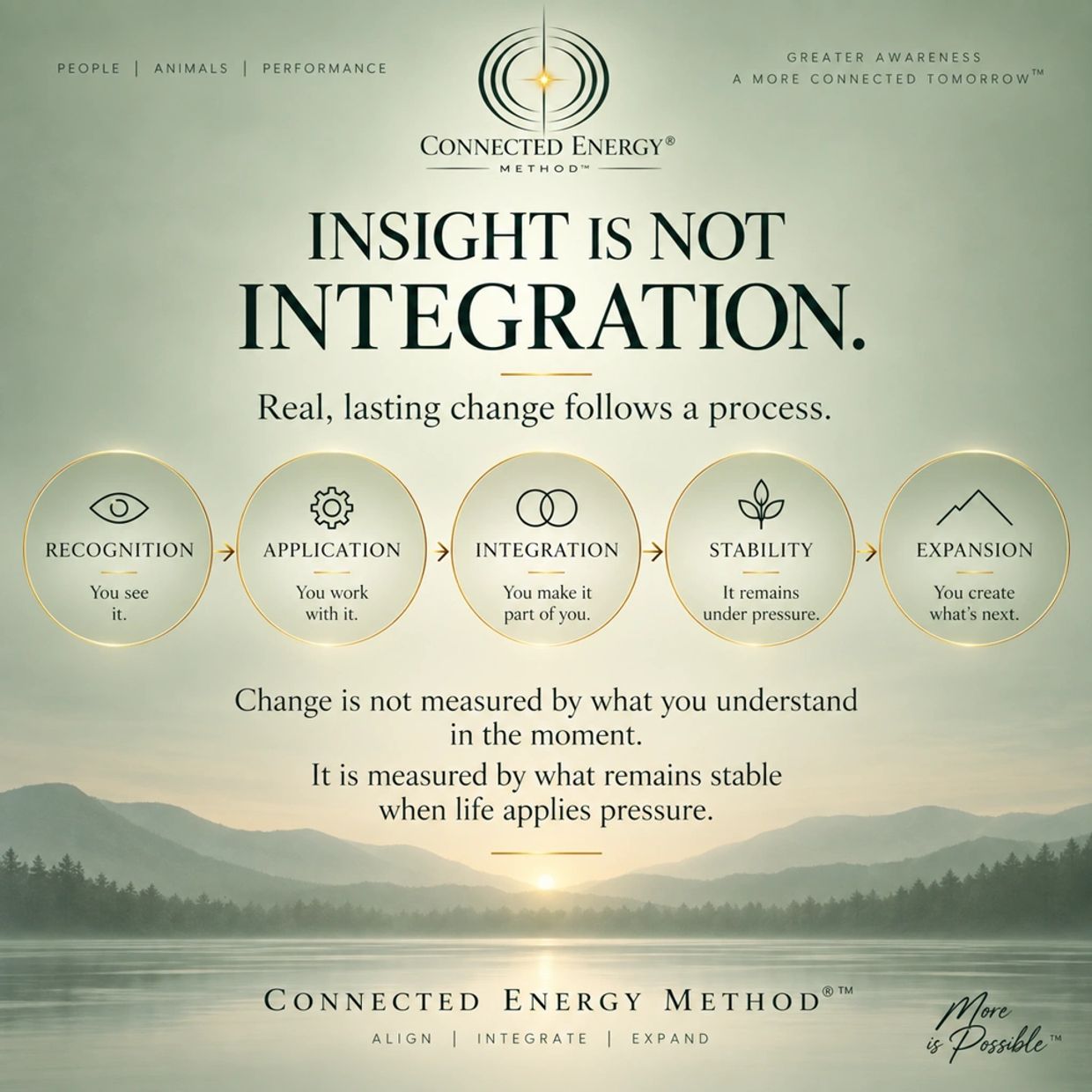
Connected Energy® Method™ is not built around creating a breakthrough moment and calling the work complete. Insight creates recognition. The deeper work is integration—taking what has been recognized and allowing it to change how the system functions, responds and makes choices over time.
A change has not fully integrated simply because it has been understood or because something feels different in the moment. Integration becomes visible when the new response becomes increasingly stable and continues to hold under stress, uncertainty, increased demand or changing circumstances.
This progression can be visually featured as:
The objective is not simply for something to happen. It is for the change to become stable enough that the individual or animal no longer automatically returns to the structure that was producing the original outcome.
This applies across the full scope of Connected Energy® Method™—including physical health and function, behavior, relationships, decision-making and performance.
Connected Energy® Method™ works where behavior, perception and physiology intersect.
The presenting problem shows where instability has become visible. It does not necessarily tell us what is producing it.
CEM therefore looks beneath the visible problem at the interacting conditions and patterns that appear to be producing and maintaining the outcome.
The objective is not simply to change what is visible. It is to identify where stability has been lost, what is participating in the outcome, and what needs to change for a different outcome to become possible.
In CEM, a system refers to the area of life or performance being examined and the conditions interacting within it.
A system might involve someone's career, business or finances; a legal situation; relationships or family; emotional health; physical health; leadership or performance; or an animal and the conditions affecting its
health, behavior, recovery or performance.
A system is rarely one isolated factor. Physical condition can affect behavior. A legal or financial situation can affect perception, physiology and decision-making. Relationships can influence emotional and physical responses. An animal's physical condition, environment, history, workload and human relationships may interact with one another.
CEM looks at those relationships because the place where a problem becomes visible is not always the place where it originates.

Structure refers to the way the relevant conditions within that system are organized, interacting and influencing the outcome.
Structure can include actual circumstances, behavior, perception, physiology, environment, relationships, load, timing, decision patterns and other relevant conditions.
The structure is therefore larger than any single symptom or problem.
This is why CEM asks:
What structure is producing the outcome?
A paradigm is an underlying framework through which circumstances are perceived, interpreted and responded to.
Paradigms can include beliefs, assumptions, expectations, learned patterns and established ways of understanding what something means or what is expected to happen.
A paradigm may influence behavior and decision-making, but it is one possible element within the larger structure. CEM does not assume that every outcome is created by mindset or belief.
Physiology, environment, relationships, actual circumstances, history, load and other conditions may also be participating.
CEM therefore looks at the whole structure rather than reducing a complex outcome to a single explanation.
The Role of Paradigms
A paradigm may influence behavior and decision-making, but it is one possible element within the larger structure. CEM does not assume that every outcome is created by mindset or belief.
Looking at the Whole Structure
Physiology, environment, relationships, actual circumstances, history, load, and other conditions may also be participating. CEM, therefore, looks at the whole structure rather than reducing a complex outcome to a single explanation.
A system is rarely one isolated factor. Physical condition can affect behavior. A legal or financial situation can affect perception, physiology, and decision-making.
Relationships can influence emotional and physical responses. An animal's physical condition, environment, history, workload, and human relationships may interact with one another. CEM looks at those relationships because the place where a problem becomes visible is not always the place where it originates.
This work supports individuals carrying sustained responsibility—whether in executive leadership, healthcare, law, entrepreneurship, family systems, or performance environments involving animal partners. The method is not defined by profession. The circumstances in which CEM is applied can vary widely.
The system being examined may involve career, leadership, or business; financial or legal circumstances; relationships or family; emotional health; physical health; human performance; an animal's health, behavior, recovery, or performance; or interactions among several of these areas.
These are not separate methodologies or disconnected service categories. They are different environments in which the same underlying principles can be observed and addressed. The Connected Energy® Method™ is therefore not organized around a profession, diagnosis, circumstance, or species. The domain changes. The underlying system principles don't.
As responsibility expands, system load increases. Without structural alignment, force often replaces clarity. While force may produce short-term results, it gradually erodes sustainability.
Coherence produces a different outcome.
When accumulated pressure is recalibrated:
As responsibility expands, system load increases. Without structural alignment, force often replaces clarity. While force may produce short-term results, it gradually erodes sustainability.
Coherence produces a different outcome.
When accumulated pressure is recalibrated:
An animal's behavior, physiology, history, environment, workload, recovery state, and relationships can all participate in an outcome.
The Human-Animal Relationship
In some situations, the human-animal relationship is an important part of that structure. In others, instability may arise primarily within the animal, its physical condition, environment, workload, recovery, previous experience, or the interaction among several conditions.
Beyond Human Influence
The Connected Energy® Method™ does not assume that an animal's behavior or performance is simply a reflection of the human. Instead, it asks the same foundational question used throughout the method:
What structure is producing the outcome?
This allows the same methodology to be applied across companion animals, working and service animals, performance animals, animals in recovery, and animals living or working within other managed environments without creating a separate animal methodology.
The animal application remains part of the same Connected Energy® Method™.
A visible problem is information.
It tells us where something is occurring. It does not automatically tell us why.
CEM, therefore, begins with observation rather than assumption. It looks at the available evidence, recurring patterns, relevant conditions, and relationships among them before determining what appears to be participating in the outcome.
This distinction matters.
When the presenting problem is mistaken for the structure producing it, considerable effort can be directed toward the wrong level of the problem.
Greater clarity about the underlying structure creates the possibility of a more deliberate and effective response.
Connected Energy® Method™ is not organized around eliminating pressure.
It is concerned with increasing the capacity of a system to remain coherent within reality—so clarity, choice and effective action remain available as conditions change.
While the language describing this work has evolved, the core has remained consistent: identifying and stabilizing the conditions that allow people, animals and complex circumstances to function with greater coherence and sustainability.
This is structural coherence under pressure.
We use cookies to analyze website traffic and optimize your website experience. By accepting our use of cookies, your data will be aggregated with all other user data.